
The Quiet Tech Behind Why Some Tourist Streets Just Feel Safer
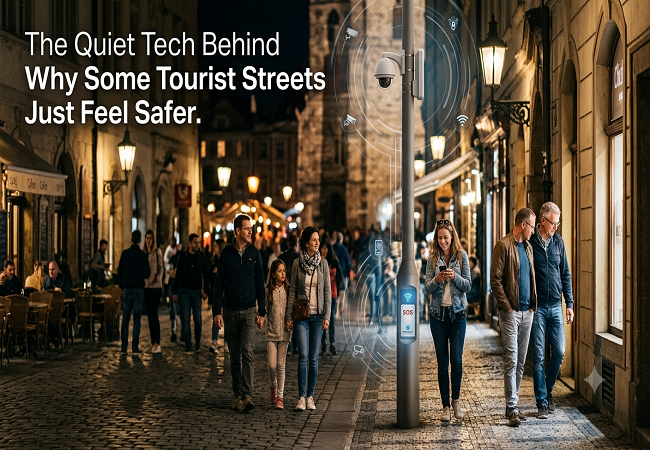
I was in a tourist market a while back — the kind of place where a scooter, a cow, two tour guides waving flags, and about forty phones-out visitors are all occupying the same fifteen feet of road — and I remember thinking: someone has to be managing this, right? Turns out, more often than you’d expect, someone is. Just not a person standing there with a whistle.
Tourist hotspots are genuinely one of the harder places to manage traffic well, and most people never think about why. It’s not one problem, it’s five problems stacked on top of each other. Locals who know the shortcuts. Visitors who are half-lost and looking up, not around. Delivery guys threading through gaps that shouldn’t exist. And pedestrians — so many pedestrians — who are thinking about lunch or a photo, not about the auto-rickshaw coming around the bend.
Why the old approach struggles here
Most traffic signals still run the way they’ve run for decades: same timing, same cycle, whether it’s a dead Tuesday morning or a Saturday during peak season with three tour buses parked wherever they could fit. Nobody programmed the signal to know the difference. It just does its thing on a loop, regardless of whether the street below it is empty or completely jammed. In a normal neighborhood, that’s a minor annoyance. In a place where thousands of unfamiliar people are trying to cross the same two streets at once, it turns into actual gridlock — and a fair bit of near-miss chaos at the crossings.
So what’s actually different now
A growing number of cities have quietly started watching these areas differently. Instead of a fixed schedule, cameras and sensors are reading what’s really happening on the ground — how many cars are backed up, how many people are bunched at a crossing, whether something’s blocking a lane that shouldn’t be blocked — and the signal timing adjusts to match.
You wouldn’t necessarily notice it as a tourist. It doesn’t announce itself. It just shows up as small things going slightly better than expected: a crosswalk signal that seems to hold a beat longer when there’s a crowd waiting, traffic near a landmark thinning out faster than it has any right to, a car that stalled near a busy gate getting towed or moved before it turns into a ten-block mess. It’s not flashy. It’s just traffic behaving the way you’d hope it would, without you knowing why.
Where this actually matters most: people on foot
Here’s the thing about tourists — they walk a lot more than they realize, and they walk distracted. Between the shop, the temple, the viewpoint, the restaurant, they’re rarely paying full attention to where cars might come from, especially in a city they don’t know. That’s exactly the mismatch that gets people hurt, and it’s exactly the gap that camera-based systems that can spot pedestrian density near a crossing are built to close.
There’s a second piece too, and it’s less obvious but arguably just as important: how fast someone finds out something’s gone wrong. A stalled scooter or a minor fender-bender near a crowded attraction can back up an entire street in minutes — anyone who’s been stuck behind one knows exactly how fast that spirals. Systems that catch this the moment it happens, instead of waiting for someone to notice and call it in, give local authorities a real head start on clearing it before it becomes the kind of jam that eats up someone’s whole afternoon.
What it actually means if you’re the one traveling
Honestly, you’re not supposed to notice any of this — that’s sort of the whole point. Good traffic management around a tourist spot shouldn’t be a visible feature. It should just mean the crossing felt a little less nerve-wracking, the wait was a little shorter than you braced for, and you didn’t spend five minutes stuck in the middle of the road wondering if that auto was actually going to stop for you.
As more cities put this kind of real-time monitoring around their busiest, most-photographed corners, the payoff isn’t dramatic. It’s just the boring, unglamorous part of travel — getting from the market to the monument without incident — quietly working a bit better than it used to. And honestly, that’s probably the highest compliment you can pay a traffic system: you never had to think about it at all.

Eswaravel Ekambaram is Co-Founder & COO of Katomaran Technologies, driving operations, system architecture, and enterprise deployment of AI video analytics, video management systems and IoT solutions.